Tranche 2 AML/CTF Readiness Toolkit for Accounting Firms
AUSTRAC-first readiness guide for accounting firms. Key dates, scope, obligations, official accountant starter kit links, and an operational workflow for Tranche 2 compliance by 1 July 2026.
From 1 July 2026, AML/CTF obligations apply if your firm provides a designated service with a geographical link to Australia. <a href="https://www.austrac.gov.au/amlctf-reform/reforms-guidance/before-you-start/summary-obligations-reform" target="_blank" rel="noopener noreferrer">(AUSTRAC)</a>
This AUSTRAC-first guide covers the key Tranche 2 dates, what "captured" usually looks like for accounting firms, and a practical sequence to build an AML/CTF program that actually operates. It also links directly to AUSTRAC's official accountant starter kit documents and shows where Nelvo helps you execute the workflow and evidence trail.
What "operational" means (in plain English): trained staff, onboarding and customer due diligence happening through a consistent workflow, escalations and reporting paths defined, evidence retrievable by client and by obligation, and reviews scheduled and recorded.
> [TIP] Maintain your AML/CTF program, staff training and client onboarding workflows as part of ongoing compliance. Enrolment opened on 31 March 2026.
---
Table of contents - Key dates you are working to - Are you likely captured - What AUSTRAC expects, and how Nelvo helps - A practical build sequence that avoids rework - AUSTRAC accountant starter kit and document library - Common traps that waste months - Where Nelvo fits, briefly - Sources
---
Key dates you are working to - 31 March 2026: enrolment opens for newly regulated businesses. <a href="https://www.austrac.gov.au/amlctf-reform/preparing-changes-if-youre-newly-regulated" target="_blank" rel="noopener noreferrer">(AUSTRAC)</a> - 1 July 2026: tranche 2 obligations commence. <a href="https://www.austrac.gov.au/amlctf-reform/preparing-changes-if-youre-newly-regulated" target="_blank" rel="noopener noreferrer">(AUSTRAC)</a> - 29 July 2026: enrolment deadline was 28 days after commencement for newly regulated businesses providing designated services that commenced on 1 July 2026. <a href="https://www.austrac.gov.au/amlctf-reform/reforms-guidance/before-you-start/summary-obligations-reform" target="_blank" rel="noopener noreferrer">(AUSTRAC)</a>
Two additional deadlines to note: - Newly regulated businesses had until 29 July 2026 to notify AUSTRAC of their AML/CTF compliance officer (per transitional rules). <a href="https://www.austrac.gov.au/reforms/amlctf-transitional-rules-update" target="_blank" rel="noopener noreferrer">(AUSTRAC)</a> - First independent evaluation deadlines for newly regulated businesses are staggered, with the earliest possible deadline 1 July 2029, then staged in 6-month intervals (based on your AUSTRAC account number). <a href="https://www.austrac.gov.au/reforms/amlctf-transitional-rules-update" target="_blank" rel="noopener noreferrer">(AUSTRAC)</a>
---
Are you likely captured
AUSTRAC is clear on the legal trigger: designated service + geographical link to Australia = must enrol. <a href="https://www.austrac.gov.au/amlctf-reform/reforms-guidance/before-you-start/find-out-when-enrol-and-register-reform" target="_blank" rel="noopener noreferrer">(AUSTRAC)</a>
Here's the practical reality: most full-service accounting firms will be captured because of what they actually do. The regime regulates services, not job titles. If your firm helps clients with structures (companies, trusts), transactions, managing funds, entity setup, or anything that moves money or ownership around, you are very likely in scope.
If you want a fast scope check, spend 60 minutes doing a service inventory: - Which services involve creating or restructuring entities (company, trust, etc)? - Which services involve handling or controlling client money, accounts, or transactions? - Which services involve arranging or executing transactions (domestic or international)? - Which services involve complex structures, offshore elements, or higher-risk client types?
> [TIP] If you answer "yes" to any of the above in a meaningful way, stop debating scope and start building the program and workflow.
AUSTRAC's professional services guidance explains the designated professional services and examples. <a href="https://www.austrac.gov.au/amlctf-reform/reforms-guidance/before-you-start/new-industries-and-services-be-regulated-reform/professional-services-reform" target="_blank" rel="noopener noreferrer">(AUSTRAC)</a>
---
What AUSTRAC expects, and how Nelvo helps
AUSTRAC sets expectations for newly regulated businesses. By 1 July 2026 you must have an AML/CTF program, a compliance officer, staff training, and be ready to engage with customers and report suspicious matters. <a href="https://www.austrac.gov.au/amlctf-reform/preparing-changes-if-youre-newly-regulated" target="_blank" rel="noopener noreferrer">(AUSTRAC)</a>
Here is a practical mapping to execution.
| AUSTRAC expectation | What "good" looks like in a firm | How Nelvo helps (practical, not theoretical) | |---|---|---| | 1) Enrol and (if relevant) register | You know your go-live services and key personnel, and you can enrol quickly from 31 March 2026 | Readiness dashboard: capture required details early, assign owners, track due dates and evidence | | 2) AML/CTF program tailored to your business | Risk assessment, policy, and procedures that match what staff actually do | Starter packs plus workflow alignment so your program does not drift from operations | | 3) Staff readiness and training | Role clarity, training completion, and consistent onboarding behaviour | Training template and attestations, completion evidence, and reminders for refreshers | | 4) Customer due diligence (initial and ongoing) | A repeatable onboarding and verification workflow that scales by risk | Risk and verification workflow tool: guided CDD, verification, triggers, escalation, ongoing reviews | | 5) Reporting and escalation | Staff know triggers, escalation routes, and timeframes; decisions are recorded | Escalation trails and evidence capture to support reporting and defensible decision making | | 6) Record keeping and auditability | Evidence is retrievable fast, by client and by obligation | Evidence register and audit trail, not scattered inbox archaeology |
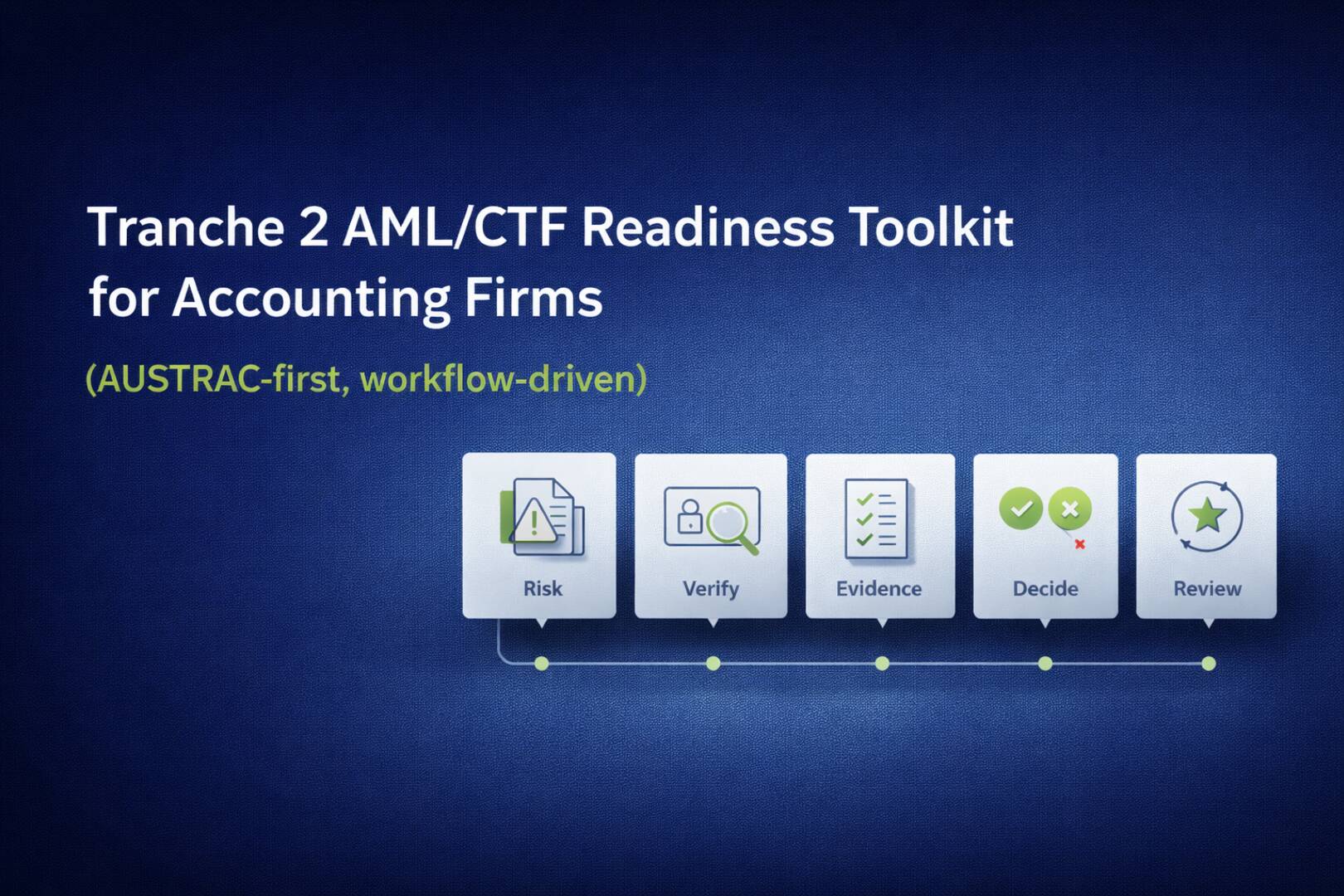
> [INFO] This maps directly to the operational workflow we run in Nelvo: Risk → Verify → Evidence → Decide → Review. This is the difference between "we have a program" and "we can prove the program operates".
---
A practical build sequence that avoids rework
Most firms do this backwards by writing policies first. That creates rework because the workflow is not real yet.
Use this order instead.
1) Confirm scope quickly Confirm which service lines are likely designated services in your practice. Use that to decide which engagement types require AML steps.
2) Set your risk settings once, then reuse them everywhere AUSTRAC's accountant starter kit is built around risks linked to kinds of clients, services, channels, jurisdictions, controls, and review cycles. <a href="https://www.austrac.gov.au/reforms/sector-specific-guidance/accountant-guidance/accounting-program-starter-kit/accounting-program-starter-kit-getting-started" target="_blank" rel="noopener noreferrer">(AUSTRAC)</a>
If your risk assessment does not change what you do day-to-day, it is just paper.
3) Operationalise CDD and verification as a guided workflow (this is the bottleneck) AUSTRAC's "use your program" step makes it clear you apply CDD and verification before providing the designated service, then detect triggers, escalate, decide, and monitor. <a href="https://www.austrac.gov.au/reforms/sector-specific-guidance/accountant-guidance/accounting-program-starter-kit/step-2-use-your-accounting-program" target="_blank" rel="noopener noreferrer">(AUSTRAC)</a>
This is where software saves you: staff do not have to remember everything, and you get consistency and an evidence trail.
4) Make escalation and reporting real, not theoretical Your staff need a simple pathway: trigger → escalate → decision → report if required.
AUSTRAC sets expectations that you are ready to engage with customers and report suspicious matters by 1 July 2026. <a href="https://www.austrac.gov.au/amlctf-reform/preparing-changes-if-youre-newly-regulated" target="_blank" rel="noopener noreferrer">(AUSTRAC)</a>
5) Finalise the program documents last (so they describe reality) Once the workflow is operating, customise AUSTRAC's risk assessment, policy document, and process document. <a href="https://www.austrac.gov.au/reforms/sector-specific-guidance/accountant-guidance/accounting-program-starter-kit/step-1-customise-your-accounting-program-using-starter-kit" target="_blank" rel="noopener noreferrer">(AUSTRAC)</a>
6) Lock in maintenance and independent evaluation cadence early AUSTRAC expects ongoing maintenance and independent evaluation. Transitional rules allow a staggered deadline for your first independent evaluation, with the earliest possible date 1 July 2029. <a href="https://www.austrac.gov.au/reforms/amlctf-transitional-rules-update" target="_blank" rel="noopener noreferrer">(AUSTRAC)</a>
---
AUSTRAC accountant starter kit and document library
If you do not want to drown in documents and admin, while still being exposed in an audit, skip to Where Nelvo fits, briefly.
AUSTRAC's accountant guidance and starter kit is the best baseline for small accountancy firms, and a strong reference point for everyone else.
Start here: - <a href="https://www.austrac.gov.au/reforms/sector-specific-guidance/accountant-guidance" target="_blank" rel="noopener noreferrer">Accountant guidance</a> - <a href="https://www.austrac.gov.au/reforms/sector-specific-guidance/accountant-guidance/accounting-program-starter-kit" target="_blank" rel="noopener noreferrer">Accounting program starter kit overview</a> - <a href="https://www.austrac.gov.au/reforms/sector-specific-guidance/accountant-guidance/accounting-program-starter-kit/accounting-program-starter-kit-getting-started" target="_blank" rel="noopener noreferrer">Getting started</a> - <a href="https://www.austrac.gov.au/reforms/sector-specific-guidance/accountant-guidance/accounting-program-starter-kit/step-1-customise-your-accounting-program-using-starter-kit" target="_blank" rel="noopener noreferrer">Step 1: Customise</a> - <a href="https://www.austrac.gov.au/reforms/sector-specific-guidance/accountant-guidance/accounting-program-starter-kit/step-2-use-your-accounting-program" target="_blank" rel="noopener noreferrer">Step 2: Use your program day-to-day</a> - <a href="https://www.austrac.gov.au/reforms/sector-specific-guidance/accountant-guidance/accounting-program-starter-kit/step-3-maintain-and-review-your-accounting-program" target="_blank" rel="noopener noreferrer">Step 3: Maintain and review</a>
Document library (all templates in one place): <a href="https://www.austrac.gov.au/reforms/program-starter-kits/accountant-guidance/accounting-program-starter-kit/accounting-program-starter-kit-document-library" target="_blank" rel="noopener noreferrer">AUSTRAC Document Library</a>
AUSTRAC notes that after customising your program, most practices will only need a small number of forms day-to-day. <a href="https://www.austrac.gov.au/reforms/program-starter-kits/accountant-guidance/accounting-program-starter-kit/accounting-program-starter-kit-document-library" target="_blank" rel="noopener noreferrer">(AUSTRAC)</a>
Core AUSTRAC documents (direct DOCX links) - <a href="https://www.austrac.gov.au/sites/default/files/2026-01/Accountants%20-%20Customise%20guide%20-%20January%202026.docx" target="_blank" rel="noopener noreferrer">Customise guide (January 2026)</a> - <a href="https://www.austrac.gov.au/sites/default/files/2026-01/Accountants%20-%20Risk%20assessment%20-%20January%202026.docx" target="_blank" rel="noopener noreferrer">Risk assessment (January 2026)</a> - <a href="https://www.austrac.gov.au/sites/default/files/2026-01/Accountants%20-%20Policy%20document%20-%20January%202026.docx" target="_blank" rel="noopener noreferrer">Policy document (January 2026)</a> - <a href="https://www.austrac.gov.au/sites/default/files/2026-01/Accountants%20-%20Process%20document%20-%20January%202026.docx" target="_blank" rel="noopener noreferrer">Process document (January 2026)</a>
Useful operational forms (examples) - <a href="https://www.austrac.gov.au/sites/default/files/2026-01/Accountants%20-%20Customer%20forms%20-%20Onboarding%20form%20-%20Individual%20or%20sole%20trader%20-%20January%202026.docx" target="_blank" rel="noopener noreferrer">Onboarding form, individual and sole trader</a> - <a href="https://www.austrac.gov.au/sites/default/files/2026-01/Accountants%20-%20Customer%20forms%20-%20Initial%20customer%20due%20diligence%20form%20-%20Individual%20or%20sole%20trader%20-%20January%202026.docx" target="_blank" rel="noopener noreferrer">Initial CDD form, individual and sole trader</a> - <a href="https://www.austrac.gov.au/sites/default/files/2026-01/Accountants%20-%20Customer%20forms%20-Onboarding%20form%20-%20Body%20corporate%2C%20partnership%20or%20unincorporated%20association%20-%20January%202026.docx" target="_blank" rel="noopener noreferrer">Onboarding form, body corporate, partnership or unincorporated association</a> - <a href="https://www.austrac.gov.au/sites/default/files/2026-01/Accountants%20-%20Customer%20forms%20-%20Initial%20customer%20due%20diligence%20form%20-%20Body%20corporate%2C%20partnership%20or%20association%20-%20January%202026.docx" target="_blank" rel="noopener noreferrer">Initial CDD form, body corporate, partnership or association</a> - <a href="https://www.austrac.gov.au/sites/default/files/2026-01/Accountants%20-%20Customer%20forms%20-%20Escalation%20form%20-January%202026.docx" target="_blank" rel="noopener noreferrer">Escalation form</a> - <a href="https://www.austrac.gov.au/sites/default/files/2026-01/Accountants%20-%20Customer%20forms%20-%20Periodic%20review%20and%20update%20form%20-%20January%202026.docx" target="_blank" rel="noopener noreferrer">Periodic review and update form</a> - <a href="https://www.austrac.gov.au/sites/default/files/2026-01/Accountants%20-%20Customer%20forms%20-%20Trigger%20event%20review%20and%20update%20form%20-%20January%202026.docx" target="_blank" rel="noopener noreferrer">Trigger event review and update form</a>
---
Common traps that waste months
> [WARNING] These mistakes cost firms months of rework. Avoid them by building your workflow first. - Writing policies before your workflow is real. You will rewrite it. - Letting risk sit in a document. Risk has to drive what staff do. - Evidence scattered across email and file shares. If you cannot retrieve it fast, it is functionally non-existent. - Treating escalation and reporting as "later". After 1 July 2026, AUSTRAC has stated it will focus <a href="/blog/what-happens-if-accounting-firm-does-not-comply-aml-ctf">enforcement</a> on entities that wilfully ignore obligations or are not ready with a program, compliance officer, staff training, and the ability to engage and report suspicious matters.
---
Where Nelvo fits, briefly
AUSTRAC provides the baseline program structure and templates. Nelvo helps you implement that baseline quickly and then run it as an operating model, with consistency across staff and a defensible evidence trail.
Nelvo supports firms in two ways:
1) Starter packs you can implement fast Nelvo includes starter packs designed to align with AUSTRAC expectations and add operational maturity beyond baseline templates: - Policies and procedures starter pack A practical AML/CTF program baseline (policy plus procedures) mapped to core obligations, with clear ownership and review cadence so the program is usable, not shelfware. - Obligation controls and control library starter pack Controls linked to each obligation, including ownership, frequency, required evidence, and status tracking, so you can show the program is operating. - Risk register starter packs Firm-level risk registers and settings that support kinds of clients, services, delivery channels, jurisdictions, triggers, mitigations, residual risk, and review cycles. - Staff training starter pack A basic training template you can deploy immediately, including onboarding, refresher cadence, and completion evidence.
2) Workflow and evidence, not just documents Templates do not run your firm. Nelvo operationalises the work through a consistent workflow: Risk → Verify → Evidence → Decide → Review
That means: - guided risk and verification workflow (CDD, verification, risk rating, triggers, escalation, ongoing monitoring) - evidence capture and retrieval discipline (by client, by obligation, by event) - readiness tracking, ownership, and audit trail for maintenance and independent evaluation preparation
If you want the simplest path: use AUSTRAC's starter kit as the authoritative reference, and use Nelvo to run the workflow and maintain the evidence trail that proves the program is operating.
---
Sources - <a href="https://www.austrac.gov.au/amlctf-reform/preparing-changes-if-youre-newly-regulated" target="_blank" rel="noopener noreferrer">AUSTRAC: Preparing for the changes if you're newly regulated</a> - <a href="https://www.austrac.gov.au/amlctf-reform/reforms-guidance/before-you-start/summary-obligations-reform" target="_blank" rel="noopener noreferrer">AUSTRAC: Summary of obligations (reform)</a> - <a href="https://www.austrac.gov.au/amlctf-reform/reforms-guidance/before-you-start/find-out-when-enrol-and-register-reform" target="_blank" rel="noopener noreferrer">AUSTRAC: Find out when to enrol and register</a> - <a href="https://www.austrac.gov.au/amlctf-reform/reforms-guidance/before-you-start/new-industries-and-services-be-regulated-reform/professional-services-reform" target="_blank" rel="noopener noreferrer">AUSTRAC: Professional services reform guidance</a> - <a href="https://www.austrac.gov.au/reforms/sector-specific-guidance/accountant-guidance/accounting-program-starter-kit" target="_blank" rel="noopener noreferrer">AUSTRAC: Accounting program starter kit</a> - <a href="https://www.austrac.gov.au/reforms/program-starter-kits/accountant-guidance/accounting-program-starter-kit/accounting-program-starter-kit-document-library" target="_blank" rel="noopener noreferrer">AUSTRAC: Document library</a> - <a href="https://www.austrac.gov.au/reforms/amlctf-transitional-rules-update" target="_blank" rel="noopener noreferrer">AUSTRAC: Transitional rules update</a>