Feature Spotlight: Nelvo's Risk & Verification Workflow for Accounting Firms
See how Nelvo's Risk & Verification Workflow helps accounting firms move from fragmented KYC and risk assessment processes to a more consistent, evidence-backed AML/CTF workflow.
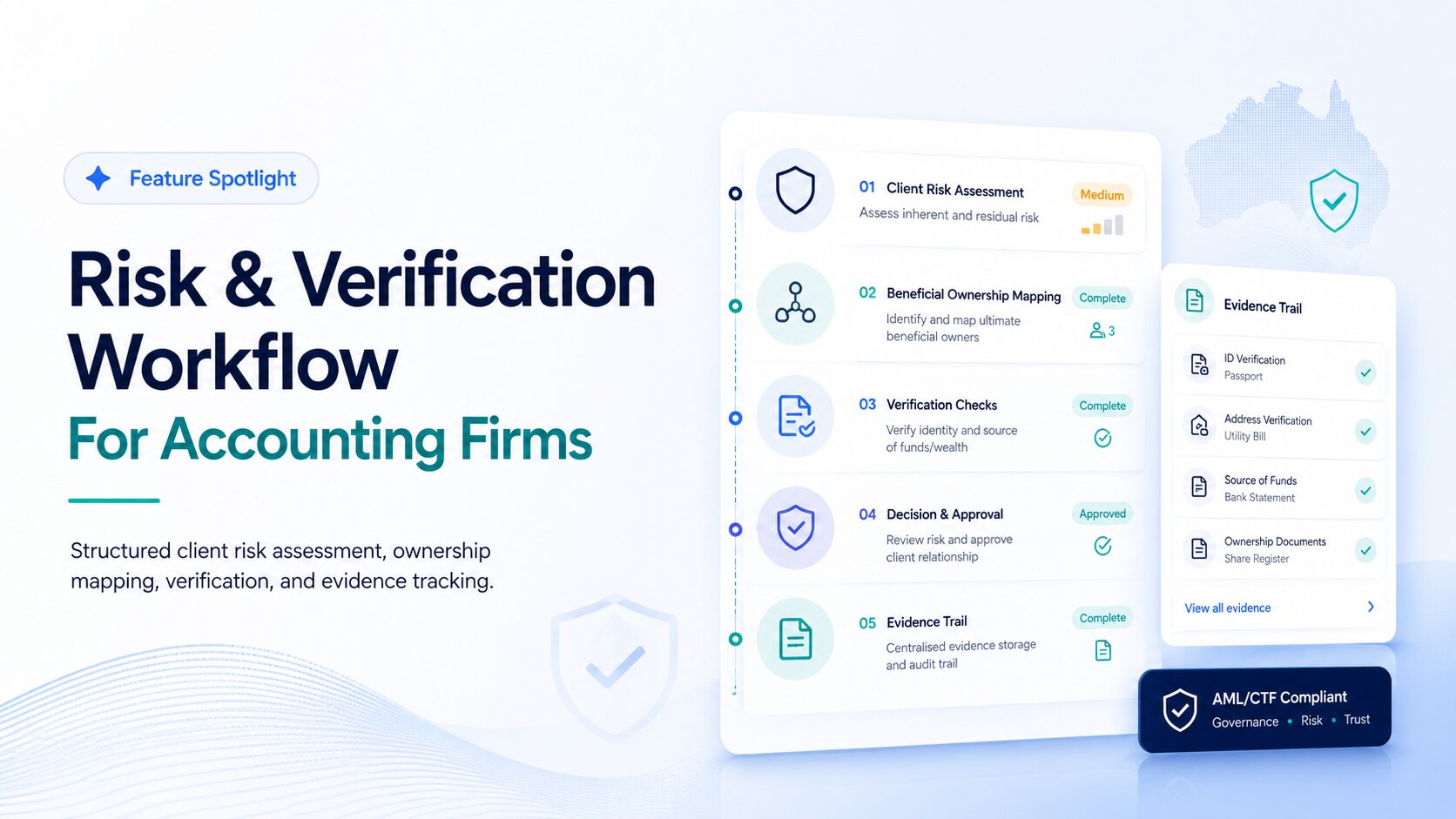
For many accounting firms, the challenge is not understanding that client risk needs to be assessed. The challenge is running that process consistently, capturing the right information, and keeping a clear record of how decisions were made.
That is where fragmented processes become a problem.
If client risk assessments sit across spreadsheets, Word documents, PDFs, onboarding notes, email chains and memory, it becomes much harder to show a consistent approach. It also becomes harder to maintain oversight, support staff, review higher risk matters, and retain a reliable evidence trail.
Nelvo's <a href="/risk-verification-cdd-accountants">Risk & Verification Workflow</a> is designed to help accounting firms move that work into a more structured, practical and auditable process.
Accounting businesses that provide designated services need more than a policy document: they need a way to operationalise risk and compliance activity in practice. <a href="/tranche-2-day-one-readiness">AML/CTF Program Readiness & Reviews</a> helps firms do that.
What is Nelvo's Risk & Verification Workflow?
Nelvo's Risk & Verification Workflow is the part of the platform designed to help firms work through client risk assessment and verification in a structured way.
Rather than relying on disconnected templates or one-off judgement calls, the workflow gives firms a clearer process for capturing relevant information, considering risk indicators, recording ownership and control details where relevant, documenting decisions, and maintaining supporting evidence.
In practical terms, the workflow helps bring together: - key client and matter information - beneficial ownership and related party mapping where relevant - risk indicators and risk outcomes - verification steps and supporting evidence - decision, approval and review records
The objective is not to turn professional judgement into a tick-box exercise. The objective is to make that judgement more consistent, visible and supportable across the firm.
Why accounting firms need a more structured process
A lot of firms are still used to compliance tasks living in multiple places.
A staff member may collect some information in an onboarding call. Another person may save identification documents in a folder. A partner may hold part of the rationale in their head. An approval might happen by email. A risk rating may be implied, rather than clearly recorded.
That kind of process can feel manageable when volumes are low. It becomes much harder to defend when the firm grows, more staff are involved, or higher risk matters start to appear.
A more structured workflow helps reduce issues such as: - inconsistent assessment between team members - incomplete ownership or control records - unclear reasoning behind a risk outcome - difficulty showing what evidence was relied on - poor visibility for reviewers or compliance leads - time lost chasing documents and past decisions
In other words, the issue is not just efficiency. It is governance.
How the workflow supports a risk-based AML/CTF approach
A risk-based approach is about more than collecting identification documents.
It means understanding the nature of the client, the services being provided, the ownership and control structure where relevant, any geographic or behavioural risk factors, and the overall level of money laundering or terrorism financing risk the firm may reasonably need to manage.
Nelvo's Risk & Verification Workflow is built to support that operational process.
1. Capturing risk information in a more consistent way
A risk-based approach depends on firms gathering and assessing relevant information. If that process is inconsistent, the quality of the outcome becomes inconsistent too.
The workflow helps guide staff through the capture of information that contributes to a more considered risk outcome, rather than relying on ad hoc notes or incomplete checklists.
2. Supporting customer risk ratings
A firm's policies should not sit in isolation from day-to-day activity. They need to translate into how customer risk is assessed in practice.
The workflow helps firms apply their internal approach more consistently by recording relevant risk factors and producing a clearer basis for the overall risk position reached on the client or matter.
3. Recording beneficial ownership and related party information
Where entities are involved, understanding ownership and control is a critical part of getting the picture right.
Nelvo supports the capture and mapping of parties and ownership details so the firm has a more coherent record of who is involved, how they are connected, and what that means for assessment and verification activity.
This is particularly important when the client structure is not straightforward, or where different parties need to be identified, reviewed or evidenced.
4. Supporting due diligence activity and verification decisions
Verification is rarely just a yes or no exercise. Firms may be using manual processes, relying on external electronic verification providers, or combining both depending on the matter and the risk profile involved.
The workflow gives firms a place to record what verification approach was used, what evidence was obtained, and what that meant for the overall assessment.
That helps create a clearer line between information collected, checks performed, and the decision ultimately made.
5. Creating a stronger decision and approval trail
One of the biggest weaknesses in manual processes is that the final decision often lacks context.
A file might show a completed form, but not why the risk was assessed in a certain way. It might show documents, but not how concerns were resolved. It might show an outcome, but not who approved it and on what basis.
Nelvo helps firms retain a more complete picture by bringing together the inputs, rationale, evidence and approval pathway in one workflow.
What the workflow helps your firm capture
While each firm's process will differ, Nelvo's Risk & Verification Workflow can help bring together information such as: - client and matter details - service context - entity and individual party details - ownership and control mapping - identity and verification records - risk indicators and contextual notes - overall risk outcome - exceptions, unresolved items or escalation points - reviewer or approver sign-off - linked <a href="/evidence-audit-trail">supporting documents and evidence</a>
This makes the record more useful not only at the point of onboarding or assessment, but later when the file is reviewed, revisited or challenged.
A practical example
Imagine an accounting firm is taking on a new company client with multiple related parties and a layered ownership structure.
Without a structured workflow, the team may collect director and shareholder details in one place, hold beneficial ownership notes elsewhere, store documents in separate folders, and discuss the actual risk position informally.
That creates friction straight away.
Now imagine the same matter in Nelvo.
The team records the relevant client and matter information, maps the parties and ownership structure, captures the verification approach used, documents relevant risk indicators, links supporting evidence, and records the final outcome along with any approval or exception notes.
The result is not just a cleaner file.
It is a more usable compliance record. If the matter needs to be revisited later, the firm has a clearer line of sight over what was done, why it was done, and what evidence supported the outcome.
Why this matters for firm admins, compliance officers and staff
The value of a structured workflow looks slightly different depending on who is using it.
For firm admins and leadership, it helps support consistency and gives better visibility over how the firm is operationalising its process.
For compliance officers or reviewers, it provides a stronger basis for oversight, escalation, and evidence retention.
For staff, it reduces guesswork and makes it easier to follow a more repeatable approach.
That matters because good compliance processes should not depend on one person remembering how a file was handled six months ago.
They should be understandable, repeatable and reviewable.
Nelvo is not just a KYC tool
This point is worth making clearly.
Nelvo is not positioned as just a standalone KYC check tool. It is a broader AML/CTF program management platform designed to help firms manage risk and compliance activity more holistically.
The Risk & Verification Workflow sits within that broader framework.
That means firms are not just completing a one-off check. They are building a more connected process that links risk assessment, evidence, governance, reviews and broader program management activity.
Final thoughts
As AML/CTF obligations come into sharper focus for accounting firms, the real question is not whether risk and verification activity needs to happen.
It does.
The real question is whether the firm can run that activity in a way that is consistent, supportable and practical.
Nelvo's Risk & Verification Workflow is designed to help firms do exactly that, by moving risk and verification out of fragmented processes and into a clearer operational workflow.
For firms that want a more usable way to assess client risk, capture ownership information, support verification decisions and maintain a stronger evidence trail, this is one of the key parts of the platform to look at.
Frequently asked questions
Is Nelvo an electronic KYC provider?
No. Nelvo is not just an electronic KYC provider. It is designed to help firms manage the broader AML/CTF workflow around risk, verification, evidence and governance. Where relevant, firms may also use external verification providers as part of their process.
Can Nelvo support entity ownership and related party mapping?
Yes. Nelvo supports party and ownership mapping so firms can retain a clearer record of entity structures and related parties where that is relevant to the matter.
Does this replace legal or compliance advice?
No. Nelvo is a software platform that helps firms operationalise and evidence their internal process. It does not replace legal advice or professional judgement.
Why does a structured workflow matter?
Because a structured workflow makes it easier to apply a consistent process, retain evidence, support approvals, and revisit matters later with a clearer understanding of how the outcome was reached.
Explore Nelvo
If you would like to see how Nelvo's Risk & Verification Workflow fits into the broader AML/CTF program management process for accounting firms, you can <a href="/risk-verification-cdd-accountants">explore the Risk & Verification feature page</a>, learn more about <a href="/tranche-2-day-one-readiness">AML/CTF Program Readiness & Reviews</a>, or book a demo with our team.