Feature Spotlight: Nelvo's Program Review and Firm Risk Review for AML/CTF Program Readiness
See how Nelvo's Program Review and Firm Risk Review help accounting firms move from scattered AML/CTF processes to a clearer program readiness, risk review, action tracking, and evidence process.
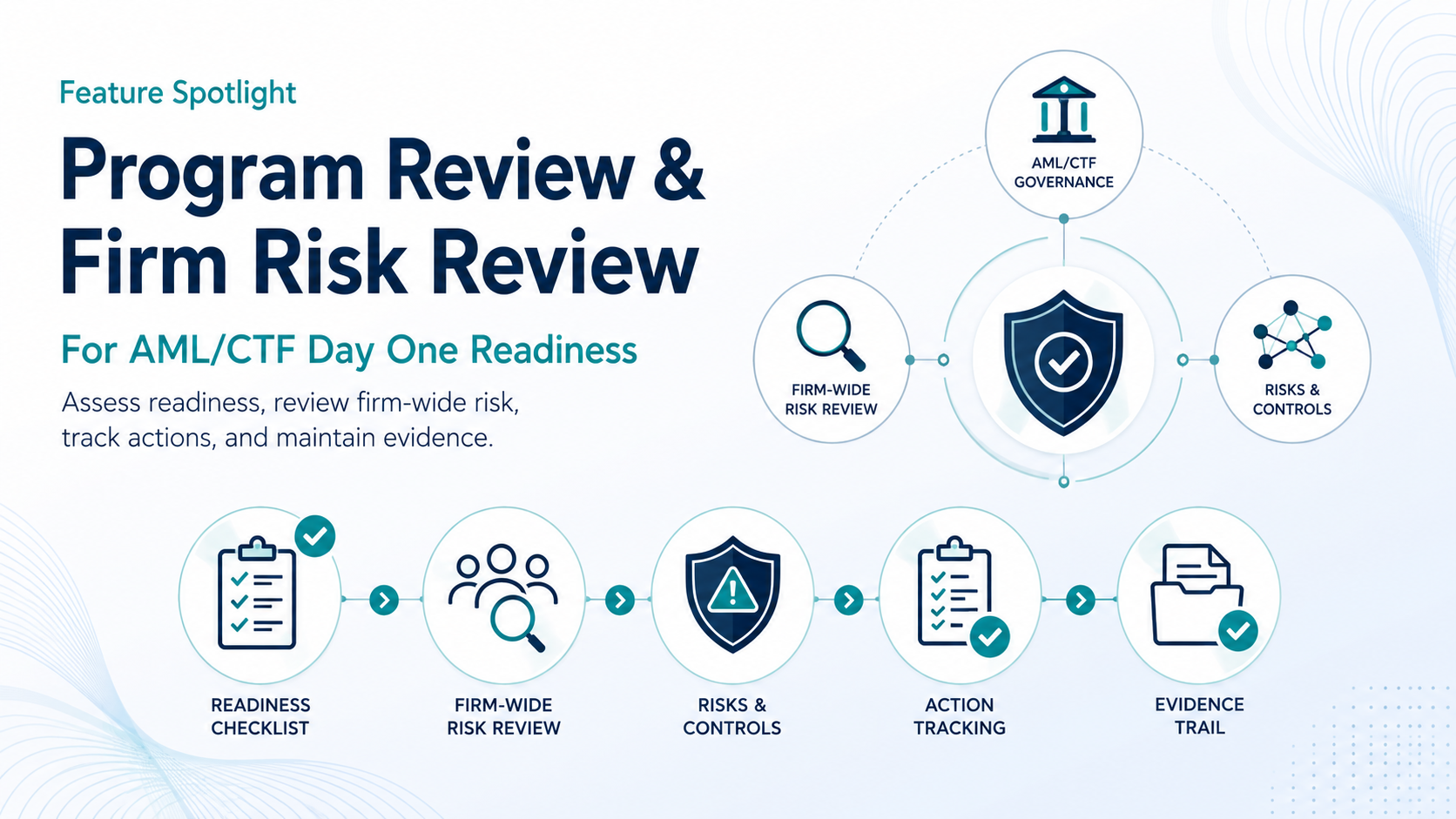
For accounting firms operating under AML/CTF obligations, program readiness is not just about having documents in place.
It is about being able to show that the firm has thought through its risks, assigned responsibilities, reviewed its controls, tracked gaps, and kept evidence of the work being done.
That is where many firms can get stuck.
Policies might sit in one folder. Risk registers might sit in another. Controls might be listed in a spreadsheet. Actions might be tracked in email. Evidence might be scattered across different locations. On paper, the firm may look like it is progressing. In practice, it can be hard to see what is ready, what is still missing, what risks need attention, and who owns the next step.
Nelvo's Program Review and Firm Risk Review are designed to help accounting firms bring that work together into a clearer, more structured program readiness and review process.
<a href="/tranche-2-day-one-readiness">AML/CTF Program Readiness & Reviews</a> helps firms do more than hold a starter pack: it supports ongoing implementation, review and evidence management.
What is Nelvo's Program Review?
Nelvo's Program Review is a structured workflow designed to help firms assess and review the state of their AML/CTF program.
It helps firms step back from individual tasks and look at the broader program. That includes whether key areas have been considered, whether risks and controls are documented, whether actions are being tracked, and whether evidence is available to support the position the firm has reached.
The goal is simple.
A firm should be able to understand where it stands, what still needs attention, and what evidence supports its readiness position.
Program Review is the broader readiness and oversight layer. It helps firms look across the AML/CTF program and ask whether the program is actually being implemented, not just documented.
What is Nelvo's Firm Risk Review?
Nelvo's Firm Risk Review is the part of the platform designed to help firms assess their firm-wide money laundering and terrorism financing risk exposure.
This matters because client-level risk assessment is only one part of the picture. A firm also needs to understand its own risk profile.
That means looking at the nature of the firm, the services it provides, the types of clients it deals with, how services are delivered, where exposure may exist, and whether the controls in place are suitable for the risks identified.
Nelvo's Firm Risk Review helps firms work through that assessment in a structured way.
The workflow is designed to help firms consider areas such as: - business profile - exposure hotspots - inherent risk scoring - control and weakness assessment - supporting evidence - remediation actions - summary and review outcomes
The point is not to create a theoretical risk document that gets forgotten.
The point is to help the firm build a clearer view of its actual risk exposure and what it is doing about it.
Why program readiness needs more than a document pack
A starter pack can be useful. Policies, procedures, registers and templates all have a role.
But documents alone do not prove that a firm has implemented its program properly.
The harder questions are usually operational: - Has the firm reviewed its actual ML/TF risk exposure? - Has the firm completed a firm-level risk review? - Are responsibilities clear? - Have gaps been identified? - Are actions being tracked? - Are controls linked back to risks and obligations? - Is there evidence to support the work that has been completed? - Can a compliance officer, partner or reviewer understand the current position quickly?
This is where static documents can fall short.
They may explain what the firm intends to do, but they do not always show what has actually been done, what is still open, what risks have been assessed, and what needs to happen next.
How Program Review and Firm Risk Review work together
Program Review and Firm Risk Review are related, but they are not the same thing.
Program Review helps the firm assess the broader state of its AML/CTF program. It is about readiness, oversight, gaps, actions and evidence.
Firm Risk Review helps the firm assess its own ML/TF risk exposure. It is about understanding the firm's risk profile, where exposure exists, how significant that exposure may be, and whether the firm's controls are appropriate.
Together, they give the firm a more useful operating view.
Program Review asks:
Are we ready, and are we managing the program properly?
Firm Risk Review asks:
What risks does our firm actually face, and how are we managing them?
That distinction matters.
A firm could have documents in place but still have a weak understanding of its risk exposure. It could also understand its risks but fail to track actions, evidence and program readiness properly.
Nelvo is designed to help bring those pieces together.
How this supports a risk-based AML/CTF program
A risk-based AML/CTF program should reflect the firm's actual business and risk exposure. It should not be generic.
For accounting firms, that means looking at the services being provided, client types, ownership structures, delivery methods, geographic exposure, payment behaviour, and other risk factors that may affect the firm's exposure.
Nelvo's Program Review and Firm Risk Review support that by helping firms turn risk and readiness work into a more active process.
1. It helps firms assess readiness more clearly
A common problem with implementation projects is that progress feels busy but unclear.
People are reviewing documents, updating templates, importing registers, running meetings and assigning tasks. But leadership may still struggle to answer a basic question:
Are we actually ready?
Program Review gives firms a clearer way to assess that position.
It helps turn broad readiness work into a more visible process, where key areas can be reviewed, tracked and supported by evidence.
2. It helps firms review their actual risk exposure
Firm Risk Review adds a deeper layer by helping the firm assess its own risk profile.
This includes thinking through how the firm operates, what services it provides, what types of clients it works with, where exposure may exist, and whether the firm's controls are strong enough for the risks identified.
This is important because a firm's AML/CTF program should not be copied and pasted from a generic template.
It should reflect the firm's actual risk environment.
3. It connects risks, controls and obligations
A useful compliance program should not treat risks, controls and obligations as separate lists that never speak to each other.
The connection matters.
Obligations help define what the firm needs to do. Risks help identify where the firm could fall short or be exposed. Controls help show how those risks are being managed or mitigated.
Nelvo is designed to support that connection across the broader platform. Program Review and Firm Risk Review help firms look across those areas and understand whether the program is functioning as a connected system.
That is important because a firm does not just need to say it has policies. It needs to be able to show how its program works in practice.
4. It makes gaps easier to see
One of the biggest risks in readiness work is false confidence.
A firm may have most of the right documents, but still have open gaps in ownership, evidence, training, controls, implementation, or firm-wide risk assessment.
Program Review helps make readiness gaps more visible.
Firm Risk Review helps make risk exposure and control weaknesses more visible.
Together, they help the firm see what needs attention before small gaps become larger governance problems.
5. It creates a clearer action trail
Finding a gap is only useful if the firm can do something with it.
Program Review helps firms move from "we should fix this" to a clearer action trail. That means identifying what needs to happen, who is responsible, and what evidence will support completion.
Firm Risk Review supports the same discipline from a risk perspective. If a risk or weakness is identified, the firm can record the issue, consider the control response, assign action, and retain evidence.
For accounting firms, this matters because AML/CTF readiness is not usually one person's job. Partners, compliance officers, administrators and staff may all be involved in different parts of the process.
A structured action trail helps reduce confusion and makes follow-up easier.
6. It supports review and continuous improvement
Program readiness is important, but it is not the end of the story.
AML/CTF programs need to be maintained and reviewed over time. Risks can change. Services can change. Delivery channels can change. Customer types can change. Staff can change. Technology can change.
That means the program needs a way to stay current.
Program Review helps firms create a rhythm for review, rather than treating AML/CTF as a one-off implementation project.
Firm Risk Review helps firms revisit their risk profile as the business changes.
What Program Review and Firm Risk Review help your firm capture
While each firm's process will differ, Nelvo can help capture and organise areas such as: - current readiness status - program review notes - firm risk review activity - business profile information - exposure hotspots - inherent risk scoring - control and weakness assessment - identified gaps - remediation actions - ownership and responsibility - linked risks, obligations and controls - supporting evidence - review outcomes - approval or oversight records
The value is not just having this information somewhere.
The value is having it in a format that can be revisited, reviewed and understood later.
A practical example
Imagine a mid-sized accounting firm operating under AML/CTF obligations.
The firm has imported starter policies and procedures. It has started reviewing its services. It has appointed internal owners. It has begun looking at customer risk, training, incident reporting and evidence retention.
But progress is spread across meetings, documents, emails and individual notes.
A partner asks a simple question:
What still needs to be done before we are ready?
Then another question follows:
Have we actually reviewed the firm's own ML/TF risk exposure?
Without a structured review process, those questions can take hours to answer. Someone has to check the documents, review the registers, chase updates, confirm who owns each task, and piece together the status from different locations.
With Program Review and Firm Risk Review in Nelvo, the firm has a clearer place to assess readiness, review firm-wide risk, identify gaps, track actions, and link evidence.
That does not remove the need for judgement.
It gives the firm a better way to organise and evidence that judgement.
Why this matters for compliance officers and firm leaders
For compliance officers, Program Review helps create visibility.
It gives them a clearer way to identify what has been reviewed, where the gaps are, what actions are open, and what evidence supports the current position.
Firm Risk Review adds another layer by helping them understand the firm's actual risk exposure and whether controls are aligned to that exposure.
For firm leaders, this supports oversight.
Partners and senior managers should not need to dig through folders and email chains to understand whether the program is progressing or whether the firm has properly considered its risk profile. They need a clear view of status, risk, actions and accountability.
For staff, it reduces uncertainty.
When the program is structured properly, staff are less likely to rely on guesswork. They can understand the process, follow the right steps, and see where their work fits into the broader compliance picture.
Program Review, Firm Risk Review and independent evaluation readiness
A strong internal review process can also help prepare the firm for future review or independent evaluation.
An independent evaluation is separate from the firm's own internal review. However, the quality of the firm's internal records, actions, risk assessments and evidence will usually make that process easier to support.
If the firm can show what it reviewed, what it found, what risks it identified, what it changed, who approved it, and what evidence supports the decision, it is in a much stronger position than a firm trying to reconstruct the story after the fact.
That is why evidence matters.
Not just evidence that documents exist, but evidence that the program has been reviewed, risks have been considered, gaps have been tracked, and action has been taken.
Nelvo is built for ongoing program management
Nelvo is not designed to be a one-off document repository.
The broader purpose is to help firms manage their AML/CTF program as an active operating framework. Program Review and Firm Risk Review are key parts of that.
They sit alongside areas such as: - <a href="/blog/nelvo-risk-verification-workflow-accounting-firms">Risk & Verification Workflow</a> - Firm Risk Register - Obligations - Control Library - Document Library - Evidence Register - Incident Reporting - Training Management
Together, these areas help firms move away from fragmented compliance activity and toward a more connected system of work.
Final thoughts
Program readiness is not about holding documents that look complete.
It is about being able to explain what the firm has done, what risks it has identified, what still needs attention, and how it is managing the work involved.
For accounting firms, that means having more than policies in a folder.
It means having a practical way to review the program, assess firm-wide risk, track gaps, assign actions, link evidence, and keep the program current as the firm changes.
Nelvo's Program Review and Firm Risk Review are designed to support that work.
They help firms move from scattered implementation activity to a clearer, more defensible readiness and risk review process.
For firms operating under AML/CTF obligations, that clarity matters.
Frequently asked questions
Is Program Review the same as Firm Risk Review?
No. Program Review looks at the broader state of the firm's AML/CTF program, including readiness, actions, gaps and evidence. Firm Risk Review focuses more specifically on assessing the firm's own ML/TF risk exposure and how those risks are being managed.
Why does a firm need a firm-wide risk review?
A firm-wide risk review helps the firm understand its own ML/TF risk exposure. This may include the services it provides, the types of clients it works with, how services are delivered, and whether current controls are appropriate for the risks identified.
Is Program Review the same as an independent evaluation?
No. Program Review is an internal workflow to help a firm assess, track and evidence its own readiness and review activity. An independent evaluation is a separate process and should be conducted in line with the firm's AML/CTF obligations and requirements.
Does Nelvo decide whether our firm is compliant?
No. Nelvo is a software platform that helps firms structure, manage and evidence their AML/CTF program activity. The firm remains responsible for its own program, decisions, records and compliance obligations.
Why does program readiness matter?
Program readiness matters because firms need to be able to operate their AML/CTF program in practice, not just hold policy documents. A clearer review process helps firms identify gaps, assign actions, assess risk, and retain evidence of implementation work.
Can Program Review and Firm Risk Review support ongoing compliance?
Yes. These workflows are not just for initial implementation. They can help firms review and maintain their AML/CTF program over time as risks, services, staff, systems and customer types change.
How does this connect to the Risk & Verification Workflow?
The Risk & Verification Workflow supports client-level risk and verification activity. Program Review and Firm Risk Review support the broader firm-level view of AML/CTF readiness, risk exposure, controls, actions and evidence.
Explore Nelvo
If your firm is operating under AML/CTF obligations, Nelvo can help you move from static documents and scattered tasks to a clearer program management process.
Read the related <a href="/blog/nelvo-risk-verification-workflow-accounting-firms">Feature Spotlight on Nelvo's Risk & Verification Workflow</a>, explore how Nelvo supports <a href="/tranche-2-day-one-readiness">AML/CTF Program Readiness & Reviews</a> for accounting firms, or browse more articles on the <a href="/blog">Nelvo blog</a>.